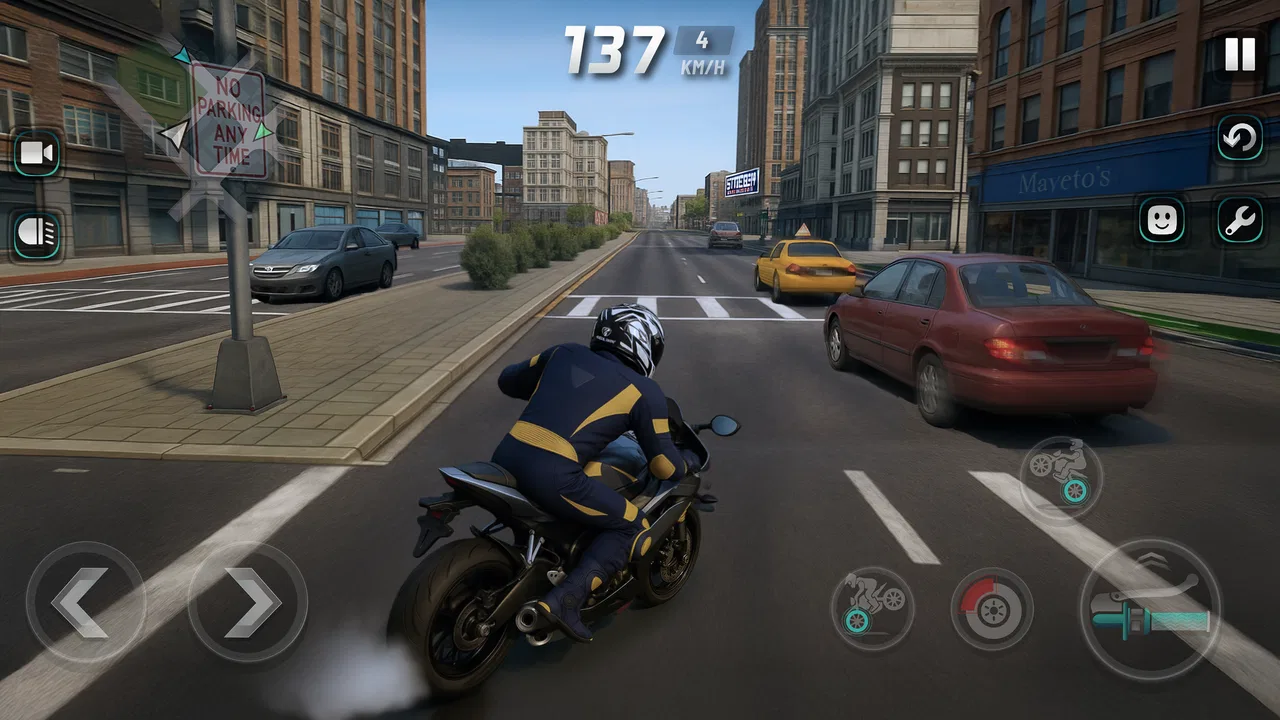
Extreme Motorcycle Simulator
- 3.9
- Rating
- 10.00M
- Installs
- Free
- Price

 Analysis by App-foxy
I approached Extreme Motorcycle Simulator as a quick motorcycle-riding game rather than a serious racing championship, and that distinction matters. It is a free racing game from AxesInMotion Racing built around the appeal of taking a bike into an open world, finding room to move, and enjoying the feeling of speed. The idea is easy to understand, but the experience depends heavily on what you want from a mobile racer: casual freedom, stunts, and short sessions, or structured competition with deep tuning and carefully balanced events.
After spending time with it, my impression is that its strongest quality is immediacy. You can pick it up without studying a complicated rulebook, and the motorcycle theme gives ordinary free time a little more energy than a typical traffic racer. At the same time, the game is not automatically the best choice for every racing fan. Its current version, 1.4.0, feels more appealing to players who enjoy experimenting in a virtual environment than to people looking for a polished esports-style contest.
How the current version feels to play
The open-world approach changes the rhythm completely. Instead of treating every minute as a narrow race toward a finish line, I found myself thinking about where to ride next, how to approach a turn, and whether a risky maneuver was worth trying. That makes the game suitable for short bursts: a few minutes while waiting for transport, a longer relaxed session at home, or a quick return when I want movement without the commitment of a full console-style racing game.
You May Also Like

 Blood Strike: 2.5 Anniversary
Blood Strike’s Loadouts Turn Every Drop Into a Tactical Gamble
A close look at Blood Strike’s custom loadouts: how fast access to signature weapons reshapes its battle royale rhythm, rewards preparation, and narrows the gap between fights.

 Pandora - Music & Podcasts
Pandora’s Music Is Easy to Start, but Harder to Recover
Pandora’s strength is its low-effort path from a seed to a station. Its weak spot is how much confidence it asks you to place in connection, setup, and quiet recovery.

 8 Ball Pool
 Is Built on Rivalries, Rematches, and Routine
A close look at the rivalries, rematches, shared routines, and unanswered safety questions that turn a quick pool match into a persistent mobile community.

 Samsung Music
’s Quiet Strength Is Playing What You Already Own
Its reach comes less from spectacle than from dependable access to a personal library. That simplicity is both the app’s strongest retention engine and its ceiling.

 AccuWeather: Weather Radar
AccuWeather Review: A Quick, Clear Forecast for Everyday Decisions
For everyday plans, the best forecast is the one you can understand quickly. AccuWeather makes rain timing, radar, and local conditions easy to act on, with a few trade-offs.

 Hill Climb Racing
Why Hill Climb Racing Still Turns Crashes Into One More Run
A tiny car, a bumpy hill and one more upgrade: Hill Climb Racing keeps resurfacing because its simple chaos makes every near-miss feel personal.
More From Our News Desk



The store presents it as an extreme motorcycle simulator, but I would describe the experience more carefully. It aims for the fantasy of controlling a powerful bike in a spacious environment, not the exacting realism of a professional riding simulator. That is a positive for beginners because the game is less intimidating than a title that demands perfect braking points and detailed mechanical knowledge. It is also a limitation for experienced riders who expect every input to behave with strict physical accuracy.
My first practical recommendation is to spend the opening session learning the bike's response before chasing speed. Mobile motorcycle games often feel sensitive because steering, acceleration, and balance are handled through a small screen. Rushing immediately into the fastest route can make the game seem awkward when the real issue is simply unfamiliar control timing. I had a better time once I treated the first rides as practice rather than as tests of skill.
The open-world format is especially useful when I do not want a fixed objective. A traditional racing game tells me exactly what to do, which is satisfying when I want competition but restrictive when I only have a few minutes. Here, the attraction is the ride itself. I can explore, repeat a difficult approach, or use a familiar stretch of road to improve my control. That freedom is the reason I would recommend it before I recommended it for its competitive depth.
A good fit for casual riders and experimenters
This game makes sense for someone who likes motorcycles but does not necessarily follow real-world racing. It also suits players who enjoy open maps, vehicle handling, and the small satisfaction of mastering a tricky turn. Younger players can approach it easily because the content rating is Everyone, while adults may appreciate it as a low-pressure alternative to more demanding racing games.
I would be more cautious about recommending it to a player who wants a large career mode, a highly detailed garage, or a carefully organized online competition scene. Those expectations can make an open-world simulator feel unfinished even when its central riding is enjoyable. The game is best understood as a flexible playground with racing flavor, not as a complete replacement for every kind of motorcycle title.
It is also worth considering the device requirement before installing. The game supports Android devices running version 7.0 or later, so it is accessible to many users, but compatibility alone does not guarantee that every phone will deliver the same smooth experience. Open environments and vehicle movement can be more demanding than a simple two-dimensional racer. If your phone is older or tends to struggle with other 3D games, I would begin with moderate expectations and pay attention to comfort during longer sessions.
What the latest release means in practice
Version 1.4.0 is the current build, released after the game first appeared on September 24, 2025. Those details are useful because they place the experience in an early stage of its life rather than suggesting a long-established motorcycle platform. I see the current release as a foundation: the main appeal is already clear, while future refinement will determine whether the game becomes a deeper long-term destination or remains a pleasant casual ride.
I would not treat the version number as proof of a particular feature or improvement. What I can judge is the direction implied by the current product: the developers are presenting a motorcycle game where freedom and sensation matter more than a dense list of formal racing systems. That focus gives it a recognizable identity, but it also raises the standard for handling, world design, and variety. If those areas continue to receive attention, the open-world concept has room to become more convincing.
For someone who already played an earlier build, the most sensible approach is to update and judge the present handling for yourself rather than relying on old impressions. A newer version can change the feel of steering or the general balance of a vehicle game, and those differences matter more here than a small menu adjustment would in a puzzle app. Existing users should also give themselves a few rides before deciding whether the current release feels better, because muscle memory from an earlier version can make any control change feel wrong at first.
New players have a simpler advantage: they can learn the current controls without comparing them with an older version. I recommend setting aside a calm first session, trying both relaxed exploration and faster riding, and then deciding whether the handling feels natural. That test tells you more than the short store description because the main question is personal: do you enjoy correcting the bike and planning your movement, or does the control demand feel like work?
Small techniques that improve the experience
One useful habit is to separate exploration from speed practice. When I am exploring, I focus on learning the shape of the environment and identifying places where the bike can be controlled comfortably. When I am practicing speed, I repeat one route and change only one part of my approach, such as entering a turn more slowly or accelerating later. This simple workflow makes improvement easier to notice than constantly changing direction and blaming the game for inconsistent results.
Another tip is to use open space as a control laboratory. Rather than seeing empty areas as wasted scenery, I use them to test how much steering correction is needed at different speeds. This is particularly helpful on a touchscreen, where a small movement can have a larger effect than expected. It also lets a new player build confidence without the pressure of trying to perform a perfect maneuver beside obstacles or during a competitive sequence.
I also recommend treating risky riding as a choice, not as the default way to play. The excitement of an extreme motorcycle game comes from pushing the bike, but constant aggression can turn the session into repeated recovery instead of enjoyable progress. I get more value by alternating controlled runs with experimental ones. That gives the game two moods: a relaxing ride when I want to switch off, and a challenge when I want to test my reactions.
These approaches reveal a trade-off that is easy to miss in a store listing. The game can provide more freedom than a conventional level-based racer, but freedom also means the player has to create some of the structure. If you enjoy setting your own goals, that is a strength. If you need a steady sequence of clearly defined rewards, the same design may feel less motivating.
Where it sits beside other racing games
Compared with a standard arcade racer, Extreme Motorcycle Simulator offers a more personal sense of space. Arcade racers are usually better when I want immediate competition, obvious checkpoints, and a clear winner. This game is better when I want to decide whether the session is about cruising, practicing, or taking risks. Neither approach is universally superior; they serve different moods.
Compared with a dedicated motorcycle simulator, this title is easier to approach and less demanding in its presentation. A specialist simulator may satisfy players who care about technical riding behavior and detailed progression, while this game is more inviting to someone who simply wants to get on a bike quickly. The trade-off is that the accessible design may not provide the same depth for a rider who wants every part of the experience to mirror real competition.
It also differs from a traffic-focused motorcycle game. Traffic racers create tension through constant avoidance and usually make the road itself the main obstacle. An open-world motorcycle game gives me more room to choose my pace and direction. If I want an immediate reflex challenge, a traffic title may be more effective. If I want to explore and make my own route, this one has the clearer advantage.
The choice between these alternatives should come down to session purpose. For a quick adrenaline hit, a tightly structured racer may be more satisfying. For relaxed experimentation, this game is the more natural pick. I would not install it expecting it to replace every racing game on a phone; I would install it because the motorcycle-and-open-world combination offers a different kind of break.
Costs, access, and the practical decision
The game is free to install, which makes trying it straightforward. It includes in-app purchases ranging from $0.49 to $104.99 per item, so I would advise deciding in advance whether you are comfortable spending money inside a free game. The wide range means the free entry point and the possible spending experience can feel very different for different players.
My advice is to play long enough to decide whether the basic riding loop is enjoyable before considering any purchase. No optional item can fix a mismatch between your expectations and the game's open-world style. If you already like the handling and simply want to support continued play, spending becomes a personal choice. If you are still waiting for the game to become a structured championship racer, it is better to keep your wallet closed and choose a different title.
The audience size suggests that the game has attracted meaningful attention, with more than five million installs, while its average rating sits at 3.8 from roughly five thousand ratings. I read that combination as a sign of broad curiosity but mixed satisfaction rather than universal approval. The review count is around forty, which is a much smaller sample than the rating total, so I would give more weight to your own first session than to any single enthusiastic or critical comment.
That balance is important. A free game can be worth installing even if it is not flawless, because the cost of testing the core idea is low. But free access does not remove the value of your time. If the controls feel uncomfortable after a fair learning period, or if you need a richer progression system, uninstalling is a reasonable decision rather than a failure to understand the game.
What I would like to see next
The next stage should focus on depth that supports the open-world idea instead of adding complexity for its own sake. More meaningful reasons to revisit familiar areas would help players who enjoy exploration but eventually run out of self-created goals. Better ways to practice, compare personal performance, or vary the purpose of a ride could make the world feel more useful without losing its casual character.
Handling refinement is equally important. In a motorcycle game, the relationship between acceleration, steering correction, and recovery determines whether risk feels exciting or frustrating. Even small improvements in that relationship could affect the entire experience. I would rather see careful control polish than a large collection of superficial additions, because a convincing ride is the foundation on which every other feature depends.
Existing users should watch how future releases treat that foundation. If updates make riding smoother while preserving freedom, the game could become a stronger long-term recommendation. If new content arrives without addressing moments of awkward control or a lack of direction, the result may feel wider but not deeper. That is the key question I would ask before committing to regular play.
New users should watch for the same reason, but they do not need to wait to try the current release. The present version already communicates whether the basic fantasy works for you. Spend a session learning the controls, try both careful and aggressive riding, and decide whether creating your own goals feels enjoyable. That test is more useful than expecting a future update to transform the game into something fundamentally different.
My recommendation after playing
Extreme Motorcycle Simulator is a worthwhile free download for players who want an accessible motorcycle game with open-world freedom and room to invent their own challenges. I like it most when I approach it as a flexible riding playground: a place to practice control, explore at my own pace, and enjoy short sessions without the pressure of a formal tournament.
I would skip it if your priority is a deep career structure, strict simulation accuracy, or highly organized competitive racing. A conventional arcade racer may give you clearer goals, while a specialist motorcycle simulator may reward your technical interest more fully. This game occupies the middle ground, offering a more open and relaxed experience than either extreme.
Its current release feels promising because the central idea is easy to enjoy, but the long-term value depends on refinement and reasons to return. The free price and Everyone rating make it easy to test, while the in-app purchase range is a reminder to keep spending intentional. My final view is positive but measured: install it for the freedom of riding, not for promises of a complete racing career, and you will have a much better chance of appreciating what it actually does well.
FAQs for Extreme Motorcycle Simulator
01What features does Extreme Motorcycle Simulator offer?
Extreme Motorcycle Simulator provides an immersive riding experience with a variety of motorcycles to choose from. Players can explore open-world environments, perform stunts, and customize their bikes. The game also includes realistic physics and weather effects, enhancing the simulation experience. Additionally, there are multiple game modes and challenges to keep players engaged.
02Is Extreme Motorcycle Simulator free to download and play?
Yes, Extreme Motorcycle Simulator is free to download on both Android and iOS platforms. However, the game includes in-app purchases that allow players to unlock premium features, additional bikes, and customization options. While the core gameplay is accessible for free, some users may opt for these purchases to enhance their experience.
03What are the system requirements for Extreme Motorcycle Simulator?
To ensure smooth gameplay, Extreme Motorcycle Simulator requires a device with at least 2GB of RAM and a modern processor. It is compatible with Android 5.0 and above, as well as iOS 10.0 or later. Adequate storage space is also necessary, as the game includes high-quality graphics and detailed environments.
04Does Extreme Motorcycle Simulator support multiplayer modes?
Yes, Extreme Motorcycle Simulator offers multiplayer modes where players can compete against each other in real-time races. This feature enhances the competitive aspect of the game, allowing players to test their skills against friends or other online opponents. Multiplayer mode requires a stable internet connection to function properly.
05Are there any parental controls in Extreme Motorcycle Simulator?
Extreme Motorcycle Simulator includes basic parental controls, allowing parents to manage in-app purchases and screen time. The game is designed with age-appropriate content, but parents should review settings to ensure a suitable experience for younger players. It’s advisable to monitor gameplay and guide children on responsible gaming practices.
Pros
- Realistic physics enhance gameplay.
- Wide variety of motorcycles to choose.
- Detailed environments and tracks.
- Customizable bike features.
- Smooth and responsive controls.
Cons
- In-app purchases can be costly.
- Occasional frame rate drops.
- Limited offline features.
- Repetitive mission objectives.
- Ads can be intrusive.

Extreme Motorcycle Simulator
Gallery